


The Automated Workflow System That Changed Everything
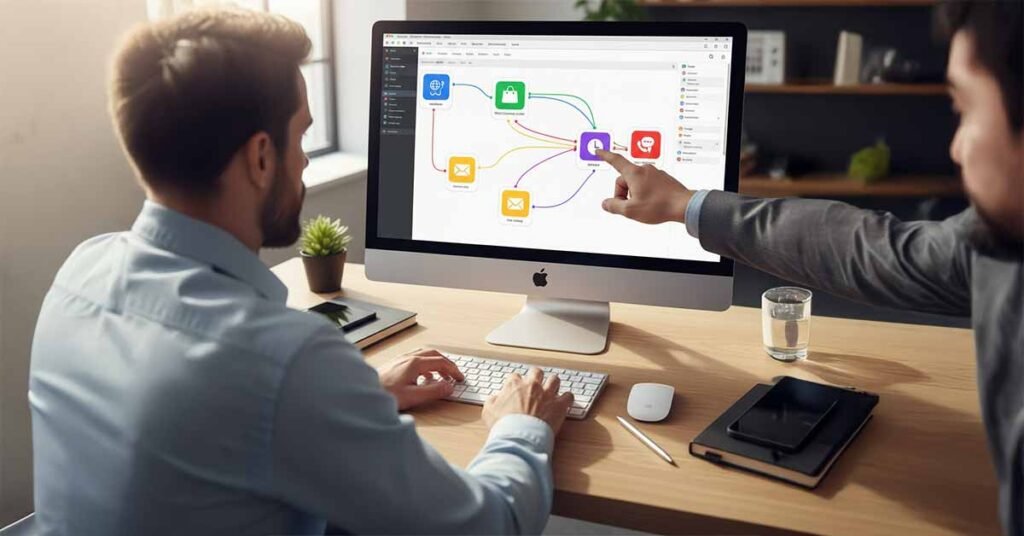
Automated workflow system technology didn’t just improve my business — it exposed a problem I didn’t even realise existed. For years, I depended on staff, manual routines, and daily back-and-forth communication just to keep things moving. Every missed message, delayed follow-up, forgotten appointment, or unanswered call silently slowed the business down.
The real issue wasn’t my team.
The real issue was dependence on humans for predictable, repetitive tasks.
Calls would come in when we were busy.
Messages would pile up when we were offline.
Bookings were missed.
Reminders were forgotten.
Leads slipped away simply because no one had the time to chase them.
It wasn’t the team’s fault — it was the system.
A business cannot grow when its workflow depends on availability, energy levels, or human memory. And that’s when I realised the truth:
👉 The business wasn’t being slowed down by people.
👉 It was being slowed down by manual processes.
This blog reveals the exact turning point — when I discovered that my entire business could run smoother, faster, and more reliably with a system designed to work 24/7.
Not by replacing people… but by replacing the repetitive work that holds businesses back.
Why 2025 Changed Everything for Business Workflows
Something major shifted in 2025 — and most business owners didn’t see it coming. Customer expectations rose faster than human teams could keep up. People now expect replies within minutes, bookings instantly, follow-ups automatically, and support 24/7.
But the truth is painful:
Most businesses are still running on outdated, human-dependent workflows
…while customer behaviour is moving at digital speed.
Phone calls at odd hours.
WhatsApp messages late at night.
DMs piling up.
Booking requests coming in during weekends.
Customer questions arriving while you’re already dealing with ten other things.
This is the new reality of running a business in 2025:
**Customers don’t wait anymore.
They move to whoever replies first.**
That’s why many businesses suddenly realised their old workflow couldn’t survive the new demand. Teams were overwhelmed, response times dropped, and opportunities slipped through the cracks — not because the staff wasn’t good, but because the system wasn’t built for today’s speed.
Competitors who adopted an automated workflow system were the first to notice something surprising:
They didn’t need more staff…
They needed fewer bottlenecks.
And that’s when a quiet but massive shift began — manual workflows started dying, and automated workflows began taking over.
The Hidden Problems With Human-Dependent Workflows
Most business owners don’t realise how fragile their workflow really is until it breaks. A human-dependent system looks fine on the surface — until you zoom in and see all the silent leaks, delays, bottlenecks, and mistakes happening every single day.
These problems don’t explode loudly…
They drain your business quietly.
Here’s what manual workflows REALLY cost you:
✔️ Delays You Don’t See
When staff are busy, tired, distracted, or multitasking, replies get delayed.
Customers don’t complain — they just move on.
✔️ Missed Messages & Lost Opportunities
WhatsApp, email, Instagram DMs, website forms, phone calls…
Humans can’t track everything at once.
One missed message = one lost customer.
✔️ Inconsistency
Some replies are fast.
Some are slow.
Some are professional.
Some are rushed.
Your brand quality becomes unpredictable because humans depend on energy, mood, and availability — not consistency.
✔️ Overload During Peak Hours
10 messages at once?
5 calls in a row?
A sudden spike of enquiries?
A human team collapses under pressure.
Customers don’t wait — they choose whoever replies first.
✔️ Human Error
Forgetfulness.
Miscommunication.
Mis-typing.
Not saving numbers.
Not updating notes.
Small errors stack up into BIG consequences.
✔️ No Staff Can Work 24/7
Customers message late at night.
They call early in the morning.
They want responses during weekends.
Your competitors with an automated workflow system don’t lose these opportunities…
because their system never sleeps.
⭐ The Realisation
The problem was never your staff.
The problem was the dependence on staff.
Manual workflows were designed for 1998, not 2025.
Businesses grow faster than humans can keep up — and that’s when everything starts breaking.
The Moment I Realised My Workflow Didn’t Need More Staff… It Needed a System
For the longest time, I thought the solution was simple:
“Hire more people.”
“Add another assistant.”
“Expand the team.”
But more staff didn’t fix the root problem — it only added:
- more delays,
- more miscommunication,
- more reminders,
- more supervision,
- more salaries,
- more inconsistency.
The truth hit me one day when I realised something uncomfortable:
**The business wasn’t failing because my team wasn’t good enough…
The workflow was failing because humans were doing tasks machines could do better.**
We were using people for work that didn’t require people at all:
- answering the same questions daily
- confirming bookings manually
- reminding clients again and again
- updating spreadsheets
- responding to WhatsApp messages
- sending follow-up texts
- checking availability
- forwarding information
- taking notes during phone calls
These weren’t “jobs.”
These were repetitive processes.
And repetitive processes don’t need humans — they need a system.
That’s when I realised:
👉 I didn’t need a bigger team.
👉 I needed an automated workflow system that could run these tasks perfectly, every time, without breaks, without excuses, and without forgetting.
This was the moment everything shifted.
Not because I discovered a new tool…
But because I discovered a new way of thinking about business.
The Tools That Make This Possible (Without Coding, Without Complexity)
Once I understood that the real bottleneck wasn’t my team but the process, everything finally clicked. I didn’t need complex software. I didn’t need to hire developers. And I definitely didn’t need a huge budget.
What I needed was a simple set of tools that could connect, communicate, and run tasks automatically — the core of any modern automated workflow system.
And here’s the part that shocked me the most:
You don’t need coding, tech skills, or engineering to automate a business in 2025.
That old belief — “automation is complicated” — is gone.
Today’s tools are built for business owners, not programmers.
Here are the categories of tools that opened my eyes:
✔️ 1. Automation Platforms (Your Workflow’s Brain)
These tools pass information from one place to another automatically.
Example abilities:
- “When a message arrives, reply instantly.”
- “When a booking is confirmed, send instructions.”
- “When a lead fills a form, store the data & follow up.”
This is the core layer of an automated workflow system.
✔️ 2. AI Communication Tools (Your Digital Front Desk)
These tools can respond to:
- SMS
- Website chat
- Instagram DMs
- Facebook messages
Without you touching your phone.
They keep the conversation alive 24/7.
✔️ 3. Booking & Scheduling Tools (Your Digital Assistant)
These systems:
- check availability
- book appointments
- send confirmations
- send reminders
- sync with your calendar
No more back-and-forth.
✔️ 4. CRM & Data Tools (Your Business Memory)
Every lead, every message, every detail is saved automatically.
No more losing numbers or forgetting follow-ups.
✔️ 5. Payment & Invoice Automations (Your Mini Accountant)
They:
- send payment links
- confirm payments
- update records
- trigger receipts
All automatically.
⭐ The big surprise:
Most of these tools cost less than hiring one part-time staff member.
And together, they form the foundation of a complete automated workflow system that handles nearly every repetitive task in a business.
This is where things start getting exciting… because once these tools connect, your business starts running itself.
The Tasks My Workflow Handles Automatically (So I Don’t Have To)
When everything finally clicked and the tools started talking to each other, I realised something insane:
**Tasks I once believed needed people…
were suddenly being done better by my automated workflow system.**
Not because my team was bad.
But because the system didn’t get tired, distracted, or overwhelmed.
Here are the exact tasks it runs every single day — without anyone sitting in an office:
✔️ 1. Instantly replying to new enquiries
No matter the time — morning, evening, weekend — new leads receive a reply within seconds.
No delays.
No missed opportunities.
No manual phone checking.
✔️ 2. Following up with leads (automatically)
If someone doesn’t reply, the system follows up politely after:
- 15 minutes
- 2 hours
- 24 hours
All pre-set, all automatic.
Your brand looks professional, responsive, and organised — without you doing anything.
✔️ 3. Booking appointments and checking availability
No more calendar chaos.
The system handles:
- scheduling
- rescheduling
- confirmations
- reminders
- calendar syncing
All without a single back-and-forth message.
✔️ 4. Sending instructions and onboarding messages
Once someone books or buys, the automated workflow system sends:
- instructions
- next steps
- location details
- preparation info
- follow-up reminders
Zero manual texting, ever.
✔️ 5. Organising customer data automatically
Every message, booking, purchase, or request is saved into a CRM — without human input.
No lost numbers.
No forgotten notes.
No messy spreadsheets.
✔️ 6. Processing small tasks your staff used to do
Things like:
- sending PDF brochures
- calculating totals
- updating notes
- tagging leads
- logging messages
- adding entries to sheets
All done instantly, with machine-level accuracy.
⭐ The result?
My business felt… suddenly lighter.
The repetitive “admin work” that used to steal hours every day disappeared.
Everything began running smoothly in the background.
This was the moment I realised:
I didn’t replace staff — I replaced repetitive work.
And the next breakthrough was even bigger:
When the system started handling calls and messaging with zero human involvement.
The Moment Everything Changed: When Calls & Messages Became Automated
There was one moment when I truly understood the power of automation:
When my phone stopped being a source of stress.
For years, every missed call felt like lost money.
Every unanswered message felt like poor service.
Every late reply felt unprofessional.
But once the automated workflow system took over communication, everything changed.
Suddenly…
✔️ Calls were answered even when I was unavailable
Whether it was:
- after hours
- during meetings
- weekends
- busy moments
…every call was responded to with a professional, consistent flow.
Customers instantly received:
- greeting
- information
- instructions
- follow-up options
No more voicemail.
No more “missed calls.”
No more slow responses.
✔️ WhatsApp replies became instant — 24/7
The system now:
- greets new customers
- asks what they need
- offers packages
- sends instructions
- collects details
- saves them into the CRM
- triggers follow-ups
Even at 11 PM.
Even while I’m asleep.
Even when I’m offline.
✔️ SMS & website messages automatically trigger workflows
No message disappears.
No enquiry falls through the cracks.
No lead dies because of slow human response.
The system takes over immediately, making the business feel alive at all times.
✔️ Customers now think my business is “super responsive”
And that’s the best part.
People assume I have a full support team.
They assume we’re always active.
They assume I’m always available.
But in reality?
It’s just one thing working quietly in the background:
👉 Automation doing what humans don’t have the time, attention, or energy to do consistently.
⭐ This was the turning point.
Not when tasks were automated…
But when communication was automated.
That’s the moment the business truly became self-running.
And that leads to the next breakthrough —
how much time and money this actually saves compared to staff.
The Time & Money This Saves Compared to a Full Staff
The biggest shock wasn’t that my automated workflow system could answer calls or send messages.
The biggest shock was what happened after it took over.
Suddenly, the business felt lighter.
The pressure disappeared.
The constant checking, replying, following-up, and reminding… all gone.
And that’s when the numbers started to make sense.
✔️ Time Saved Every Day
Before automation:
- Hours spent replying to messages
- Multiple phone interruptions
- Constant manual follow-ups
- Endless admin tasks
- Checking calendars & rescheduling
- Updating spreadsheets
After automation:
Most of those hours disappeared.
It felt like someone gave me back entire days of my life.
What used to take 3–5 hours daily now happens in minutes — or automatically — without me even noticing.
✔️ The Financial Difference Was Even Bigger
Hiring staff to handle these tasks would cost:
- £1,500–£2,000/month (minimum)
- salary
- training
- mistakes
- sick days
- late replies
- inconsistency
- limited hours
But the automated workflow system costs a fraction of that — and works:
- 24 hours a day
- 7 days a week
- 365 days a year
- with zero errors
- with perfect consistency
- with no downtime
This isn’t about replacing people.
It’s about replacing the repetitive tasks that drain your business without adding value.
✔️ The Unexpected Savings
What I didn’t expect was the hidden savings:
- No missed leads
- No lost customers
- No rebooking confusion
- No duplicated work
- No forgotten follow-ups
- No late replies
- No weekend backlog
Every message responded to = a chance saved.
Every follow-up sent = a customer won back.
Every call handled = revenue protected.
This is the kind of savings no spreadsheet can measure.
⭐ The Real Outcome?
The business runs smoother, cleaner, faster — and cheaper.
The team can focus on real work.
And I finally have time to grow instead of maintaining chaos.
Automation didn’t just save money —
it saved momentum.
Why This System Outperforms a Traditional Team
The deeper I went into automation, the more obvious it became:
A traditional team simply cannot compete with the consistency, speed, and accuracy of an automated workflow system.
Not because people aren’t capable.
But because people aren’t built to do repetitive tasks with machine-level precision.
Here’s what I realised very quickly:
✔️ 1. Humans get tired — automation doesn’t
Your team needs rest.
The system doesn’t.
Messages at midnight, early calls, weekend enquiries…
the automated workflow system handles all of it instantly, without complaining, pausing, or forgetting.
✔️ 2. Humans lose focus — automation stays consistent
People get distracted.
People make mistakes.
People miss steps.
Automation executes the same process perfectly, every single time, without variation.
No missed follow-ups.
No forgotten messages.
No skipped reminders.
Just pure consistency.
✔️ 3. Humans have limits — automation scales infinitely
If your business gets 10 enquiries a day, humans can manage.
If it gets 100, things break.
But the automated workflow system doesn’t care if it processes 10 or 10,000 actions — it handles everything instantly.
Your growth no longer depends on your team’s capacity.
✔️ 4. Humans need supervision — automation is self-running
People need guidance.
Monitoring.
Instruction.
Training.
Automation needs none of that.
You set it up once and it works independently.
It becomes a silent worker that never asks questions and never creates new problems.
✔️ 5. Humans make decisions emotionally — automation follows logic
Manual workflows are influenced by mood, stress, tiredness, and pressure.
Automated workflows follow rules:
- If enquiry arrives → reply
- If no reply → follow up
- If booking confirmed → send instructions
- If call missed → trigger message
Predictable.
Measurable.
Scaled effortlessly.
⭐ The truth most business owners ignore:
A team is amazing for creativity, strategy, and customer care…
But for repetitive, predictable tasks?
Automation wins every time.
And when both work together — humans + automated workflow system — your business becomes unstoppable.
This realisation leads to the final piece:
👉 How ANY business can build a system like this without tech skills, developers, or huge budgets.
How Any Business Can Build This System (Without Coding or a Big Team)
By the time my business was running smoother than ever, I realised something important:
**This isn’t a special system for “tech people.”
This is a modern business system that ANYONE can build.**
You don’t need developers.
You don’t need a software engineer.
You don’t need to understand code.
You don’t need expensive tools.
What you really need is a simple, structured setup.
Here’s exactly how any business owner can create their own automated workflow system without overwhelm:
✔️ 1. Start With the Repetitive Tasks You Want Gone
Ask yourself:
- What tasks drain your time?
- What slows your day down?
- What do you repeat every single day?
- Which activities constantly interrupt your work?
This is your automation goldmine.
✔️ 2. Decide Where You Want Instant Responses
Every business has communication bottlenecks:
- SMS
- Calls
- Website forms
- Social media messages
These are the FIRST places where automation makes the biggest impact.
✔️ 3. Map Your Ideal Customer Journey (Simple, Not Technical)
For example:
- Customer messages
- Instant reply goes out
- If no response → follow-up
- If they’re interested → send options
- If they confirm → book appointment
- If booked → send instructions
- After service → collect feedback
This is the backbone of a self-running system.
✔️ 4. Connect the Tools (It’s Easier Than You Think)
Modern automation platforms let you connect:
- messaging
- calls
- calendars
- payment links
- CRMs
- forms
- apps
…with drag-and-drop blocks.
No coding. No technical stress.
✔️ 5. Test It Once — Then Let It Run Forever
This is the magic moment.
Once the workflow is active:
- every message gets answered
- every call gets a response
- every lead gets a follow-up
- every booking gets confirmed
- every customer gets tracked
Your business finally runs itself in the background.
⭐ This is where business owners feel the shift:
You stop working in the business.
You start working on the business.
You stop being the operator.
You become the owner.
And once everything works together, you finally understand why automation is the new competitive advantage in 2025.
Ready to Build Your Own Self-Running Workflow?
If you’re tired of constant interruptions, missed messages, slow replies, and repetitive admin work… it’s time to build your own automated workflow system and give yourself the freedom to actually grow the business again.
You don’t need coding.
You don’t need a technical background.
You just need the right setup.
Start here → NanoAI Workflow Automation Services
And if you want to see how automation is transforming businesses worldwide, this guide from HubSpot explains the massive shift happening in 2025:
👉 https://blog.hubspot.com/marketing/marketing-automation
Your business can run smoother.
Your time can come back.
Your customers can get instant replies.
Your entire workflow can operate 24/7.
⭐ It starts with one decision:
Stop running the business manually…
and let the system run it for you.